

I was slogging through the livestream of last month’s Martinsville Redevelopment Commission meeting recently, and I was once again struck by general misgiving.
As is now required by the state, every redevelopment commission (RDC) in the land must prepare a “pass through” report — showing how much all the other taxing units affected by tax increment financing (TIF) districts are losing each year to the RDCs’ incessant siphons.
In the case of Martinsville, those taxing units include the public library, MSD of Martinsville, Washington Township, the city itself, the county itself, county EMS and county dispatch.
I’ve weighed in on TIF districts before, but it’s a worth a refresher, given how convoluted it can seem. So bear with me.
When originally conceived, TIF districts were intended to allow government entities to improve “blighted areas” through investment, and the “but for” test was central — Would this improvement happen “but for” government intervention?
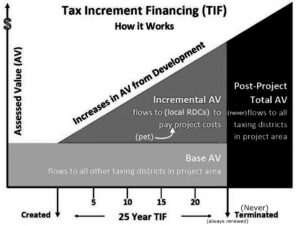
If not, local government would make the improvements and recoup some of those costs through the subsequent boost in assessed values. Ultimately, that would benefit all the other taxing units with the new and improved assessments after the 25-year lifespan of the district came to an end.
So how do they do that?
When TIF districts are created, they immediately cap the tax rate for all the taxing units within that area at the base rate. When improvements are made, the assessed value goes up (and thus, the taxes collected), and the local RDC collects the additional tax revenue while the other units remain at the base rate.
As originally intended, it’s a temporary “pain” for the other taxing units with the long term gain of boosted tax dollars on the back end. At least in theory.
The present reality of TIF districts is a far cry from the original intent.
No longer is a “blighted area” a primary requisite, nor is the “but for” test.
These days, agricultural land, commercial and even residential property can be tossed into a TIF district. A wide net can be cast, all so the RDCs can get a new revenue stream.
What’s more, TIF districts almost never go away. They are renewed again and again. The other taxing units never see the promised boost.
All they need to do is “justify” the renewal by coming up with more government projects. If those projects were focused on basic infrastructure and benefiting the general public, I might not have such strong feelings. But they often aren’t.
Mooresville’s multi-million-dollar limestone “gateway signs” are RDC funds. Mooresville’s “Main in Motion” project? RDC.
Martinsville’s new entertainment theater was paid for by RDC funds. Thus, begging the question if government should be in the entertainment business. Worthy of a discussion that never was.
So what winds up happening is that local governments grow utterly dependent on these pseudo slush funds and are incentivized to come up with perennial projects, both real and imagined. And yes, some are real projects with a clear public good — but far from all.
And here’s the worst-of-all kicker about TIF districts, they artificially inflate the tax rate! Read that again. Slowly. Then read it again.
The state tells counties the maximum they can collect in taxes each year, and then the counties and municipalities figure out how to hit that number — because, of course, they never go lower (though they could).
Well, TIF funds are not a part of that equation, so guess what happens? A higher tax rate is typically needed to hit the end-goal target.
Martinsville’s RDC report states it plainly, “If $76 million of AV (assessed value) is released back into the tax base, then the estimated taxing district rate would fall from $2.7350 (per $100) to $2.5156.”
That’s an 8-percent reduction, and that’s just the city of Martinsville.
The county, itself, has at least seven TIF districts according to its GIS, including one at the Eagle Valley power plant (in conjunction with a massive tax cut for AES), a couple in the Waverly area, the Henderson Ford area, Old Morgantown Road area, and a couple in the tiny corner across I-70 north of Monrovia.
And now they want another one, but not just anywhere.
They want it at the site of the data center! Nevermind that whole “blighted area” and “but for” nonsense.
Talk about salt in the wound.
Remember all those promises made by our county elected about how the data center would be a huge boon to our tax base, how it would help carry a big chunk of the tax burden and lighten the load for us lowly serfs — er, I mean, taxpayers?
If they create a TIF at the data center, you can kiss lowered taxes goodbye. The other taxing units can kiss any alleged tax boost goodbye.
Meanwhile, the county’s slush fund will be overflowing with milk and honey forevermore.
Make no mistake, Morgan County’s citizens are not the top priority of county government. The wealth and health of county government are its top priority.
Government cannot be run like a business. Yes, efficiency should be at the fore, but perpetual profits should not be part of the equation. And if they are, then a tax cut or refunds should soon follow. Government is here to provide goods and services as efficiently as possible, not figure out new ways to collect more money — this, in the land of self-professed conservatives.
I should not be hearing Martinsville’s building inspector brag about how much money he is making the city through fees that has us paying more for a permit ($400, to be exact) to put up a simple sign than the cost of the sign itself.
The state (and Gov. Braun) has made it abundantly clear it’s prioritizing big business over all else. As usual, I would like to think our local government would be better, that it would choose its citizens over big business.
And as usual, I remain disappointed.
Editor Stephen Crane is a husband, father of four and Morgan County native. Contact him at 765-201-0010 or at scrane@morgancountycorrespondent.com.