

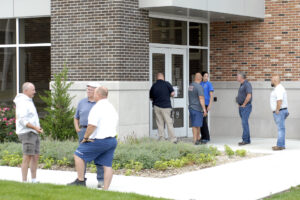
MARTINSVILLE — More than a week later, and the doors are still locked at the Morgan County Administration Building and Judicial Campus on South Main Street in Martinsville.
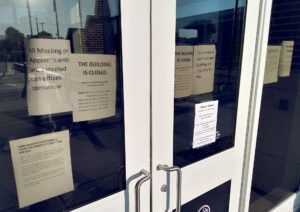
Temporary paper signs have been taped up across both entrances, notifying visitors the building is closed. Some direct those with court business to the appropriate phone number or Zoom link as judicial staffers try to keep the court calendar on schedule — despite no access to their courtrooms.
In light of ongoing testing by city, county and state experts that show no contamination, county leaders are still not sure what the culprit might be that led to elevated carbon monoxide levels in some employees last week, followed by an evacuation of the building last week — and its continued closure, per the daily decision by the three county commissioners.
“We understand that this has got to be resolved as quickly as possible,” said Morgan County Administrator Kyle Swalls on Tuesday, the seventh full day in a row the building has remained closed. “So that’s all we’re doing and all we’re thinking about right now.”
The administration and judicial building serves as the hub of county departments and activities — including everything from Veterans Services and Purdue Extension to the courts and clerk’s office.
Since last week’s closure, departments have been scrambling to provide services, and it’s been a group effort.
“I am eternally grateful to the city of Martinsville,” said Swalls, lauding the fire department and city administration, in particular. “They have absolutely stepped up and helped the county repeatedly. And it didn’t take some special ask. They came and said, ‘We’re here to help.’”
Currently, the county clerk’s office and court services are using Martinsville City Hall as a temporary home.
The Martinsville Police Station has also opened its training/conference room as a temporary meeting space for certain county boards, and that’s where the Morgan County Council met Monday night, with more budget meetings planned at that location this week.
The local public library, meanwhile, has also opened its doors to the county health department so that its services might continue.
“Thanks to the The Morgan County Public Library – Martinsville Branch, and our amazing staff, the Morgan County Health Department is up and running in the basement of the library,” the department announced on social media Monday.
But not all are able to serve the public without access to information, records or equipment that is held at their in-office location.
“Each of those (county) offices has very different missions, so the leaders of those offices will have to determine whether there are things they can ‘nibble on,’ or if the state or others have requirements on them to offer services in person,” Swalls said.
When contacted, Swalls has been directing residents to email contacts within departments, as the phones cannot currently be answered. He encouraged anyone with county business to visit the county website — morgancounty.in.gov — and look up the specific department, where email contacts should be readily available.
Initial incident
County leaders are still at a loss as to what the source cause might be that prompted employees to flood the ER of IU Health–Morgan’s emergency room last Tuesday afternoon, July 28, with more traveling to other area medical facilities.
It all started after a court staffer showed an elevated carbon monoxide level. The employee initially complained of not feeling well and visited the county’s health clinic. The employee was then sent to IU Health–Morgan for additional testing, where an elevated carbon monoxide level was detected.
On the heels of that reported level and as a precaution, additional court staffers and county employees were sent to be tested, with many going to IU Health-Morgan, others to Franciscan Health in Mooresville and still others who went to unspecified locations.
Some of those were treated with supplemental oxygen to purge any carbon monoxide from their system, and according to one employee, “at least 15 people” were treated based on the staffer’s eyewitness account.
As of this week, the county’s HR department had received reports of 61 employees — out of 138 who regularly work in the building — who had their blood tested for carbon monoxide, including 24 who went to the ER, 20 who visited to the county’s clinic and 17 more who were tested but did not indicate where.
On the heels of last Tuesday’s incident and subsequent evacuation, the county called in
CenterPoint Energy, along with the Martinsville Fire Department, to come out, inspect and test, but no cause could be found.
“They went all around the building,” said Swalls last week. “They had no indications (of airborne contaminants). Fire department, no indications on their monitors.”
In addition, the county called in the Indiana Department of Health (IDH), the Indiana Department of Homeland Security (IDHS) and the state fire marshal, while also reporting the incident to Indiana Occupational Safety and Health Administration (IOSHA).
“We’re calling everybody in we can to look at this,” Swalls said last week. “And we wanted people from outside Morgan County looking at it.”
But still, no contaminants — whether CO or natural gases — could be found.
“We don’t have a cause, and we know the monitors aren’t going off,” Swalls said.

Looking for a cause
The county employee, who wished to remain anonymous for fear of reprisal, told The Correspondent some employees have been feeling symptoms for a few weeks, including headaches and dizziness.
“This is the fourth time we’ve had to evacuate the building,” the employee said last week, pointing specifically to the boiler as a possible problem. “Something was not installed properly, and it’s never been fixed.”
According to Swalls, the boiler has, in fact, “never worked right,” but that doesn’t mean it’s the source of possible contamination.
“I do think the boilers are an important part of this discussion,” Swalls said. “But what’s really important to me is to keep our mind open to any cause. … If it’s the boilers, it’s the boilers. But I want it to be whatever it actually is.”
The judicial building — which cost $32 million of the county’s $72 million bond for the three-phase project, which also includes the historic courthouse renovations as well as those at the administration building — officially opened in July 2025, and the boilers have never operated as intended, according to Swalls.
Two boilers were installed to share the load for the building, but only one has properly functioned.
In an effort to fix the problem, a subcontractor came out to perform warranty work on the boilers in late June, resulting in a gas leak that caused some staffers to become ill and an immediate evacuation of the building.
Last Tuesday morning, the boiler manufacturer arrived to do scheduled work on the boilers, as one was still not working properly.
Following the evacuation later that day and subsequent closure of the building, Meyer Najum — the general contractor overseeing the three-phase project — and county insisted that both boilers be brought up to full operations in order to adequately test the system. But that meant parts were needed that were not on hand.
So on Friday, the Canadian manufacturer brought in the parts, and the system was brought online — with both boilers fully operational.
More tests were performed, and still no detection.
“We have not gotten a lot of clear information on what is going on,” Swalls said Tuesday.
On Monday, four volunteers — including a county commissioner — spent at least four hours inside the building. They had their blood drawn before and after to see if elevated CO could be detected.
According to Swalls, two showed elevated levels, while one stayed the same and the other dropped.
“One of my concerns was mixed results, and that’s what we got,” said Swalls, who added that none of the testing indicated levels that would be considered CO poisoning. “We’re pretty far away from that.”
What now
By and large, the county is at a standstill until an answer can be found.
The IDH has been assisting in the effort since last week. The IDHS’s hazmat specialist arrived on scene to help with testing. And the IOSHA has been involved.
On Tuesday, a staffer with the Clark County Emergency Management Agency volunteered to assist with a specialized XplorIR device — touted as an infrared tool to identify more than 5,500 gases at low concentrations.
And on Wednesday, the IDH — which “has been fantastic” — was scheduled to return.
Swalls is also working with multiple environmental science firms, hoping to schedule one or more to consult with the county.
But all of that takes time.
“We are looking at the quickest timeline that we can to serving residents, but doing that in a safe manner by allowing these experts the time they need to provide us with their evaluations and assessments on what the situation is,” Swalls said. “So we want to give space to these professionals to do best ‘next steps,’ and at the time we’ve exhausted that, once we’ve given them the time to do that, we’re going to have to reopen.
“I just want to thank the public for their patience with us. We want to keep the public safe and our employees safe, and we’re going to get opened as quick as we can.”