

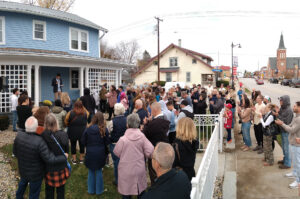
MOORESVILLE — Nearly 100 people gathered on the front lawn of a home on South Indiana Street in Mooresville on Sunday afternoon to celebrate the grand opening of a new residence devoted to men in recovery.
“We believe Jesus has the power to bring dead things back to life,” Justin White told the gathered crowd from atop the front porch steps.
White, who serves as the recovery minister at Mt. Gilead Church just east of Mooresville, is also the executive director of Hope Harbor Housing — a relatively new initiative to provide housing for those walking the road of recovery.
“Our ideal candidate is a man coming from another program who’s ready for one last place before full independence,” White said by phone Tuesday.
On Sunday evening, six such men spent their first night in the home.
Safe harbor
White’s no stranger to recovery, having battled addiction and experienced incarceration in his own life. He has candidly acknowledged those struggles from the pulpit at Mt. Gilead for years.
Given his own experiences, he was brought on staff in 2019 to begin a recovery ministry at the church, and those efforts have since exploded.
The recovery group meets every Monday evening at the church, and what started as a group of five about seven years ago has now become the largest recovery group in the state of Indiana, averaging about 300 people in attendance each week who come from all over Central Indiana.
“We’re pulling from Marion, Johnson, Hendricks, even Monroe (counties),” White said. “It definitely has become more of a regional gathering.”
That gathering includes more than a half-dozen formal recovery organizations from around the county and beyond that make the trek to Mt. Gilead every Monday evening. And through that growing network, White’s vision slowly took shape.
For the past six years, he’s supported other organizations that have established housing for those in recovery, including Martinsville-based Stability First’s efforts to begin its own housing programs, first for women via the Magdalene House and more recently, for men through the Foundations House.
White’s ministry perfectly aligned with those efforts, and he supported them at every turn. But he felt called to bring recovery housing closer to home.
“About two years ago, we got more serious,” White said, “and God just said, ‘It’s time.’”
White got to work putting together a board, which dialed in its policy framework, built its strategic partners and set out to make the vision a reality.
The result was Hope Harbor Housing.
A new beginning
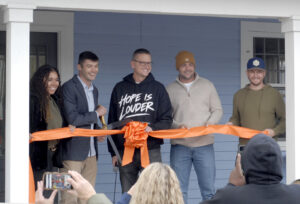
On Sunday, Hope Harbor’s board members dedicated their first home, aptly named the Anchor House. Another house for women is in the works.
It’s located just south of the town’s main intersection, and there’s a reason why.
“We wanted to be right in the heart of Mooresville,” White said. “One of my goals was that this would be a house our community would be proud of, a place where our community gets to be a part of reshaping the trajectory of someone’s life.”
In his opening remarks, White referenced a passage from Psalm 107 that speaks to crisis — and deliverance. In it, the psalmist uses a metaphor of sailors at sea, tossed by the waves and overpowered by the storms. The sailors cry out to God in distress, and their cries are heard: “He calmed the storm to a whisper and stilled the waves. What a blessing was that stillness, as he brought them safely into harbor!”
Inside Anchor House, local faith-based artist Zach Love put his touch on nearly every vertical square inch of the interior, from the walls to the staircase.
But one installation is particularly poignant for White — a work that sits near the top of the stairs and focuses on the Serenity Prayer, first popularized in Alcoholics Anonymous nearly 100 years ago and still widely used in recovery.
“And if you notice, there are pieces of that work that are reaching out beyond the frame, and I love that,” White said. “That’s the whole concept behind faith-based recovery.
“You have to reach out beyond yourself … (and) understand God can do something for me that I can’t do for myself.”
For White, the broader community plays a central role in God’s work, and that community extends well beyond his recovery group at Mt. Gilead or the nonprofits devoted to recovery. They can be found in the volunteers painting walls, or donating furniture. Those dropping off items to local food pantries or offering prayers of support and arms of comfort.
“This is a community that is welcoming, loving and supportive,” he said, “… and I think more and more, people in recovery are going to find Morgan County a place they can be restored and have a second chance on life.”