
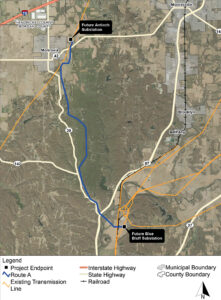
MORGAN COUNTY — At long last, AES Indiana announced Monday evening its preferred route for a planned 10-mile, 345-kilovolt transmission line connecting the future Antioch substation near Monrovia to the future Blue Bluff substation near the Eagle Valley Generating Plant in Martinsville.
AES announced its intention to construct the new transmission line — strong enough to power about 800,000 homes — back in March, and published a list of dozens of possible routes it said it was considering.
All those possibilities have been narrowed down to one, as the company announced this week that it had chosen Route A, which roughly parallels Ind. 39 along the border of Bradford Woods on its way north from the Blue Bluff substation to the Antioch substation.
Route A was ultimately selected over five other routes that had made it past initial elimination, one of which would have gone through the middle of Bradford Woods and others that would have gone into eastern Morgan County.
According to the AES website, Route A was chosen “after evaluating alternatives across engineering, environmental, community, constructability, cost and property considerations. It provided the strongest balance overall across those factors.”
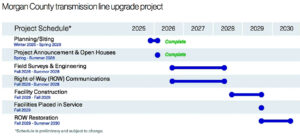
The project will make use of steel line posts towering between 115 and 195 feet, with a 200-foot wide easement along the line’s path — equating to more than 240 acres of affected land. Now that the preferred route has been chosen, AES will begin field surveys and engineering, and will ultimately begin construction in fall 2028.
Route A’s announcement will be a relief for some, and great disappointment to others.
“It’s hard to even feel relieved, because I know the concern that we felt for it coming through here, and now that’s a reality for so many families south of Monrovia,” said Autumn Sojka, a local resident and leader of the Save Morgan County group, which has opposed the transmission line project in Morgan County.
“So, while we may feel a bit of relief, I’m heartbroken for all those families,” she said. “Calling my 82-year-old neighbor (who will be affected) and giving her the news was just awful. … Now she’s wondering what she needs to do, whether she needs to move, whether she needs to fight it. Everyone is just feeling so powerless.”
In the wake of AES’s announcement, Sojka said a top priority for her and the group is to make sure those who voted in favor of this project are not re-elected.
“What happened in Morgan County should never happen again,” she said.
“If you voted ‘yes’ to a project that you knew would take multiple properties and destroy them, then you do not deserve to be in that seat at all,” Sojka added. “And that is the next thing I plan to work on. We need a change of guard here in Morgan County, we really do.”
In her capacity, Sojka was invited by Gov. Mike Braun for a “fireside chat” late last month, as part of his effort to stay connected to everyday constituents.
“He was genuinely concerned for what was happening in Morgan County,” Sojka recalled. “And he was open to hearing our concerns.”
In a followup conversation with Lt. Gov. Micah Beckwith, Sojka said Beckwith told her he had a followup discussion with Braun after her meeting and that the governor “really was bothered” that this was happening.
Braun has pushed back against an approved rate increase by AES earlier this year, and he’s repeatedly voiced concerns about protecting residential ratepayers.
Local members of the public have loudly voiced opposition of their own to the transmission line project since it was first announced earlier this year. The public has raised concerns about possible rate increases due to the project, loss of value and enjoyment of their properties, as well as environmental issues.
Eminent domain
In addition to other concerns, a number of residents have been incensed by the idea of a private utility potentially using eminent domain on their properties.
In conjunction with its Monday announcement, the company released a “property owner guide” that addresses a number of questions, including whether or not AES will use eminent domain for the transmission line upgrade.
“AES Indiana’s priority is to reach mutual easement agreements with affected landowners and avoid eminent domain whenever possible,” the guide reads. “While eminent domain is an authority available to AES Indiana, we make every reasonable effort to reach an agreement with landowners before pursuing that process.”
The company goes on to say that using its eminent domain authority is definitely not off-limits.
“Eminent domain may become necessary when AES Indiana has exhausted reasonable efforts to reach a landowner or when, after working with a landowner, we are unable to reach an agreement,” the guide reads. “Our preference is to resolve property needs through mutual agreements whenever possible.”
The company says in the property owner guide that it will work to “fairly compensate” landowners for the property rights needed for the project, and that property owners do have the ability to negotiate with AES.
Sojka, meanwhile, is hoping an advisory opinion from Indiana Attorney General Todd Rokita on eminent domain might help clarify the law and give property owners some leverage in negotiations with AES.
The Save Morgan County group is also ready to assist property owners and “help give them resources to protect their property as much as possible.”

Google’s role
Aside from issues with eminent domain, members of the public have also criticized AES for building the new transmission line solely to serve Google’s planned data center campus, a charge AES has repeatedly denied.
“Google represents significant new demand that AES Indiana must plan to serve,” the company says on its website. “But the Morgan County project is not a dedicated connection serving a single customer. Once built, the new connection becomes part of AES Indiana’s broader transmission network.”
AES testimony to the Indiana Utility Regulatory Commission (IURC) elaborated on that statement, acknowledging Google’s primary role.
“The Monrovia project represents the energy infrastructure and generation and BESS (battery energy storage safety) resources that are required primarily to serve (Google’s) incremental load and are also designed to meet the needs of other customers,” testified AES CEO Gustavo Garavaglia.
Brian Wright, a utility analyst with the Indiana Office of Utility Consumer Counselor — a state agency that represents ratepayer interests — went even further than “primarily,” connecting the AES transmission line directly with Google’s data center in his own testimony to the IURC.
When asked by the IURC whether or not AES’s projects would be necessary without the increased demand from Google, Wright’s answer was “no.”
“Based on AES Indiana’s 2025 IRP, the project would not be needed to meet AES Indiana’s capacity and energy needs if no data centers were constructed within AES Indiana’s service territory,” Wright testified. “Since AES Indiana would not need this project in the absence of (Google), AES Indiana should recover all project costs from (Google) in order to mitigate impacts to rate affordability from the project on other AES Indiana ratepayers.”
AES seems to address this concern on their website.
Under the section “Who is paying for the Morgan County transmission line upgrade” on the transmission line’s page, the company says Google will need to open up its trillion-dollar wallet.
“Under AES Indiana’s proposed rate structure, existing AES Indiana customers would not pay for the incremental transmission investments required to serve Google’s load,” the website reads. “Google would be responsible for 100 percent of the incremental generation and transmission costs required to serve its demand, including the Morgan County transmission lien upgrade.
“Those incremental costs would not be shifted to existing AES Indiana customers, even though the project will become part of AES Indiana’s broader transmission system,” the statement concludes.
It is currently unclear how many landowners will be affected by the decision. Those affected will receive direct communication from AES Indiana or its authorized representatives explaining the selected route and next steps.
The company plans to have its facilities placed in service by the fall of 2029.