

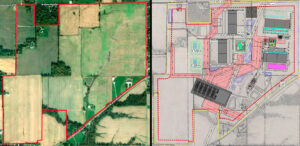
MONROVIA — New information about Google’s planned data center campus emerged last week after Monrovia residents who live near the Monroe Township construction site received mail copies of the company’s application to the Indiana Department of Environmental Resources (IDEM) for an air quality construction permit.
The application was submitted to IDEM on Feb. 13 by engineering firm Olsson on behalf of Woodland Caribou LLC, a Google shell company.
The permit application states that the planned data center campus will include a number of diesel emergency engines and associated belly fuel tanks to support each building. The application states that 160 “Type 1” diesel engines will be used, along with 19 “Type 2” diesel engines. The Type 1 generators are equipped with 5,255-gallon capacity belly tanks, and the Type 2 generators are equipped with 4,961-gallon belly tanks.
There are 179 belly tanks in total.
An air quality construction permit is required because the data center campus has the potential to emit more than 25 tons of nitrogen oxides per year, according to the application.
A report released last month by environmental watchdog group Community and Environmental Defense Services (CEDS) found that emissions from data centers can cause breathing issues and premature deaths for those living within at least 0.6 miles from data center sites.
The report found that people’s lungs can be harmed by the nitrogen dioxide and inhalable particles that are released at data center sites. The CEDS report noted that many data centers used diesel generators as backup power, singling them out as particularly strong polluters.
In addition to the diesel engines, a number of other auxiliary generators are listed in the application and will need IDEM approval. The data center campus will apparently need 36 cooling towers, one emergency administrative building engine, three emergency wastewater treatment plant engines, two emergency lift station engines, two emergency fire pump engines, two emergency site entrance engines, two emergency booster pump engines and one emergency warehouse engine.
Google’s data center plans to use electrical power provided by AES to maintain operations, but the 166 diesel engine generators will provide power to the facility in the event of power supply interruption.
The application states that the engines are “generally” only operated during emergencies, though regular cycling is typically required.
The purpose of each auxiliary generator is briefly explained in the application.
The fire pump generators are self-explanatory — they will be used for fire protection and personnel safety. The site entrance generators are for “site security.”
Meanwhile, the three wastewater treatment pump generators will be installed at the treatment plant building in case of a power outage to ensure the facility’s ability to process wastewater.
The lift station generators ensure the facility’s access to water for cooling tower operation during power outages. The booster pump generators have the same purpose.
According to the application, these emergency generators could run up to 100 hours per year as monthly testing is typically required, regardless of emergency needs.
The planned AI data center in Monroe Township has been in the works for at least two years now, with the county announcing its intentions at the beginning of last year. Google revealed itself to be the company behind the project last fall, and construction began shortly thereafter, despite widespread public opposition.
County officials have argued that a data center campus will be beneficial to local residents, as it will expand the county’s property tax base in the wake of state tax cuts enacted in 2025. Locals have had a wide variety of criticism, with concerns over water and energy needs and many believing a data center will lower property values, damage the local environment and diminish quality of life in the area.
Representatives from Google have previously told The Correspondent that the company hopes to change the community’s perspective on data centers, and to do that, the company will hold a community information fair at Monrovia Middle School on Thursday, March 19 from 5 p.m. to 7 p.m.
The event will be jointly held by Google and the Morgan County Economic Development Corp. An informational flyer about the event states that members of the community will be able to “speak directly with project leaders, engineers and local officials,” and adds that residents will be able to get their questions answered.
The flyer further advertises that people who show up can learn more about power availability and utility impacts, energy and grid modernization, water and environmental protections, air and stormwater management, traffic and infrastructure, and economic impact.