

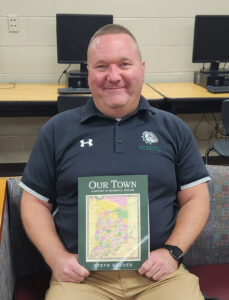
MONROVIA — Little towns like Monrovia are why some ill-informed out-of-staters like to call Indiana a “flyover state.”
In their minds, places like Monrovia supposedly have nothing to offer, other than boring old cornfields and church on Sunday. Some of the town’s own residents buy into this way of thinking. Parents send their kids to other school districts, students graduate and never look back.
Steve Reeder has set out to prove these naysayers wrong.
After almost two years of researching, writing and rewriting, the longtime Monrovia High School social studies teacher is finished with “Our Town,” a book detailing the rich history of the small town in northern Morgan County. The book chronicles the early settling of Monroe Township in the 19th century up through May 2024.
“I was worried people in Monrovia were not proud of the town,” Reeder said in an interview with The Correspondent, talking about why he set out to write the book. “I thought it was upsetting that some of our wealthier residents were sending their kids to go to school elsewhere.”
Monrovia’s schools are front and center in Reeder’s history of the town, owing both to the fact that Reeder has taught in the district for 27 years and because the Monrovia Alumni Association has contributed a great deal to the town’s history. While a significant portion of the book focuses on things like Monrovia’s government and prominent townspeople, much of the recent history in “Our Town” highlights the school district’s accomplishments.
The book’s emphasis on what the school district has given to the town is fitting — all of the proceeds are going right back to it. Reeder plans to donate all the money earned from the book to the Monrovia chapter of the Future Farmers of America.
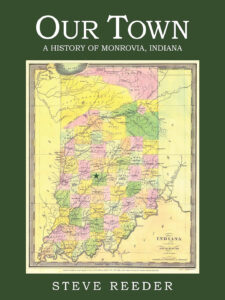
Old fashioned detective work
“Our Town” is Reeder’s first book, which is quite the feat considering it covers more than 200 years of history.
He began working on it two years ago after being named Grand Marshal of the town’s festival parade. Reeder was honored to be Grand Marshal, but he felt he had not given enough to his community to deserve the title.
So, Reeder went to work.
A year was dedicated to the research process, which involved combing through countless secondary sources, reading historical newspapers archived online and interviewing local residents about their family histories — all “old fashioned detective work,” according to Reeder.
“This is the town’s book,” Reeder said. “I would not have been able to do this without the help of the community.”
He also wouldn’t have been able to write “Our Town” without his wife, who worked with him on editing and continued to read the book over and over again to look for mistakes long after Reeder himself had grown “sick of it.”
As of presstime, the only people to have read the book besides the Reeders are the author’s parents, and according to Reeder’s mother, the book “flows well.”
Will the book have any interest to those who live outside the town’s one square mile? While Reeder says he wrote it mainly for the town’s residents, he believes the townspeople have made ripples across the state and beyond for centuries.
The first part of “Our Town” studies the Quakers who founded Monrovia, and their fierce opposition to slavery. Reeder touches on the question of if Monrovia was part of the Underground Railroad, something long believed to be true by Morgan County residents.
Later sections remark on the famous faces who hail from or have a connection to Monrovia.
One passage of the book details the Hoosier Poet James Whitcomb Riley’s visit to Monrovia, during what was one of his first public readings (apparently, it didn’t go very well.)
Another section celebrates Monrovia native Arthur Newby, one of the founders of the Indianapolis Motor Speedway. “The Greatest Spectacle in Racing” has its roots in small town America.
Beyond auto racing, Monrovia has produced a number of notable athletes and coaches. Legendary Hoosier basketball player and coach Branch McCracken hailed from Monrovia, as well as NFL wide receiver John Standeford.
And Reeder understands that history is not solely made by those “great” men and women who achieved fame beyond the town’s borders. “Our Town” features a number of appendices listing all of the past Bulldog athletes, as well as students who performed in the band and show choir, or those who achieved academic awards during their time at Monroe-Gregg.
The history of the town is just as much theirs as it is Newby’s, McCracken’s or Riley’s.
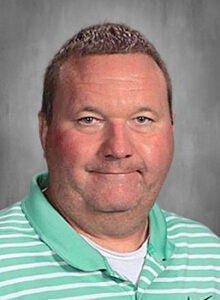
The future
“Our Town” is Reeder’s own history as well.
He’s spent most of his life in Monrovia, and he was inspired to become a history teacher at just 9 years old after learning from Mr. Noel, one of the people to whom the book is dedicated.
Reeder’s parents instilled in him a love for history as well.
“We were never a Disney World family,” Reeder said. “I went to my first battlefield when I was 8 years old.”
A respect for veterans was also instilled early in Reeder’s life, and he proudly spoke of his grandfather fighting at Normandy during World War II. Another of the book’s appendices lists the name of every American veteran from Monrovia.
Reeder feels he had a “model childhood” growing up in Monrovia. He fondly remembers playing Little League baseball, and is proud that everybody in town knew each other.
“Some think Monrovia is getting too big,” Reeder said.
For those on the outside, it may seem like nothing could be smaller than Monrovia, Ind., but one of the biggest conflicts the town has faced in recent years is disagreement on how to manage the growth the town is anticipating in the coming years.
Last year, the town predicted a thousand new homes would be built in the community over the next decade, and the looming shadow of a billion-dollar data center project hangs over the town. For some, it may seem that Monrovia’s days as a small town are numbered.
Reeder thinks differently. He personally doubts the town will see the growth that some in the local government expect, but no matter what happens, he hopes the town will retain a welcoming attitude.
“We can be proud of history,” Reeder said, “But we can’t be stuck in it.”
It’s a message that may turn out to be prescient, if the growth expectations prove correct. The arrival of “Our Town” could not have been better timed — a history of a small town just as it is about to explode.