
MORGAN COUNTY — In the midst of widespread local opposition to Google’s planned data center in Monrovia, the trillion-dollar company is offering a little sugar to local organizations to help the medicine go down.
Google announced last week that it would be spending more than $1,000,000 on at least three Morgan County organizations as part of its commitment to being a good neighbor to county residents. The Monroe-Gregg School District, Churches in Mission and the Community Foundation of Morgan County (CFMC) were the first beneficiaries to be announced by Google.
Monroe-Gregg Superintendent Trent Provo told The Correspondent that the district would be receiving $175,000 from Google. He said he did not yet know how that money would be spent.
“I am very grateful for this partnership with Google,” Provo said in last week’s press release from Google. “This partnership will allow us to create some very needed programming for our students during very financially difficult times for schools.”
School districts throughout the county have been sounding the alarm for years now on the struggles of keeping up with higher and higher costs. The Monroe-Gregg district paid more than $164,000 just earlier this month on a single 78-passenger bus.
Susan Haynes, the executive director of Churches in Mission, said Google had contacted the organization, but a specific donation amount had not been discussed.
“With the unprecedented food needs we have had in Morgan County, any funding assistance is greatly appreciated,” Haynes told The Correspondent.
CFMC President Kim Cole said she was “thrilled” the organization was included in Google’s financial commitment to the county. She said the company has asked for CFMC’s collaboration in how they can make an ongoing impact in the community.
“We are still working through the details on what that collaboration looks like, but their intention is to follow our guidance on where they can make the biggest impact,” Cole said in an email. “Our county is suffering in many areas — food insecurity and poverty related issues, childcare shortages and affordable housing, to name a few..”
Cole included Lilly Endowment with Google as two “powerhouses” committed to supporting Morgan County.
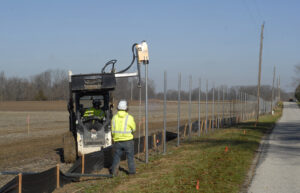
Along with its commitment to spread some financial goodwill throughout the county, Google announced that foundation and utility work on the first data center building will begin in February 2026. Heavy equipment already arrived on Keller Hill Road in Monroe-Township last month, just east of Monrovia’s town limits.
The building is part of a planned data center campus, located on nearly 550 acres of land just outside the town limits of Monrovia. The Morgan County Commissioners initially approved a rezone of 390 acres of property for data center use back in February, and in October, the county commissioners approved rezoning an additional 158 acres for Google’s data center campus.
In September, Google purchased a 79-acre farm within Monrovia’s town limits. The town of Monrovia controls how that land will be zoned.
Shortly after the commissioners approved the initial rezone, two local residents filed a lawsuit in the Morgan County Superior Court. The plaintiffs allege the data center will cause “immediate and irreparable loss of both plaintiff’s property values and their use and enjoyment of the property” and argue the rezone does not align with the county’s formal comprehensive plan.
The plaintiffs are seeking an order to vacate the commissioners grant of the petition which would halt construction on the data center, at least temporarily.
A second lawsuit with new plaintiffs was filed after the additional, 158-acre rezone was granted.
On Nov. 17, the plaintiffs in the first lawsuit filed a motion to compel the Morgan County Board of Commissioners to produce requested documents related to the lawsuit. The plaintiffs had first requested these documents on Sept. 24, and the commissioners were supposed to have handed them over by Oct. 24, but they failed to do so.
The defense had requested a two-week extension, making the new deadline to turn over documents Nov. 7. This deadline was also not met, and the defense said she would try to produce the document by Nov. 14. After this deadline was not met, the plaintiffs asked the court to intervene.
A hearing on the motion to compel discovery was scheduled for the morning of Dec. 11, but it was abruptly postponed the day before after the defense reportedly emailed the plaintiffs’ attorney the requested documents.
The defense reportedly requested that the hearing on the motion to compel discovery be dropped, but at the moment, this hearing has simply been rescheduled until the plaintiffs can determine if the commissioners completed the request satisfactorily.
The new hearing on the motion to compel discovery is currently scheduled for Jan. 23, 2026, at 9 a.m. Judge Dakota VanLeeuwen will preside.