

MARTINSVILLE — It’s been a busy few months for state lawmakers, as they’ve written, debated, amended and decided the future of hundreds of bills during the 2026 legislative session that’s set to end tomorrow.
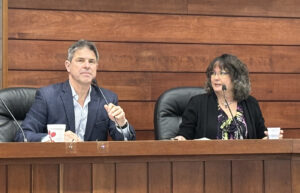
Everything from Medicaid and a constitutional amendment to relocating the Chicago Bears and renaming roads have been topics of this latest “short session,” and State Sen. Rod Bray and Rep. Peggy Mayfield, both Martinsville-based Republicans, dropped in at the Greater Martinsville Chamber’s Third House Event at the Morgan County Administration Building last week to provide updates.
Bray and Mayfield both took the time to provide major updates about what the Indiana General Assembly has been up to since the session began in December, and then they took questions from the audience.
A broad range of issues were discussed, including the politics surrounding data centers, ranked choice voting and housing affordability.
Medicaid cuts and bail reform
Bray spoke to the audience first, and his updates from the statehouse mainly focused on two things: Senate Bill 1, which makes changes to Medicaid, and a state constitutional amendment that will be on voters’ ballots at the general election in November.
SB 1 will tighten income, asset and work requirements for Medicaid and the Supplemental Nutrition Assistance Program (SNAP). The bill will also direct state agencies to share information with federal authorities regarding individuals’ immigration status.
Bray has said before that Medicaid spending in Indiana has ballooned out of control, and he did so again last Friday.
He said Medicaid cost has grown exponentially since the COVID-19 pandemic, becoming nearly a quarter of the state budget. Bray said this growth is “unsustainable,” and he framed it as conflicting with other state goals, like providing funding for education and roads.
SB 1, Bray said, would ensure that the “right people” are receiving Medicaid benefits. He had previously told The Correspondent that he believed the economic crisis associated with the pandemic required the expansion of Medicaid, but now that the pandemic is over, people who joined Medicaid are still using the program though they no longer need it.

Democrats and some Republicans at the statehouse voted against SB 1, arguing that the cuts to Medicaid would hurt some people who actually still need the program by causing them to lose their health coverage.
Democrats also opposed Senate Joint Resolution 1, the other update that Bray spoke to the audience about at Third House.
This resolution, approved by the General Assembly earlier this month, will send a constitutional amendment to voter ballots this November. Indiana voters will determine if judges will be granted more authority to deny bail to “dangerous” criminal defendants.
The Indiana Constitution currently stipulates that judges can only deny bail to defendants charged with murder or treason.
The amendment up for consideration would give judges broader authority, as Bray and other Republicans have argued that the inability to deny bail in more cases has led to additional crimes. Critics of the bill have said it will disproportionately affect marginalized communities.
The question voters will see on their ballot will look like this: “Shall the Constitution of the State of Indiana be amended to provide that a person charged with an offense other than murder or treason is not entitled to bail if: (1) the proof is evident or the presumption strong; and (2) the state proves by clear and convincing evidence that no release conditions will reasonably protect the safety of any other person or the community.”
House Bills
Mayfield spoke of several bills that the Indiana House of Representatives had been working on over the past few months, many of which should be fairly consequential if they become law.
One such bill is House Bill 1001, a bill designed to make homes in Indiana more affordable by implementing a number of deregulations. The bill will address Indiana’s housing shortage by attempting to make homes easier to build.
What lawmakers believe this will require involves limiting local zoning rules, streamlining development approvals and expanding what types of residential development must be allowed without public hearings.
The streamlining effort will likely win over housing developers, but a number of Republican and Democratic lawmakers alike have criticized the bill, arguing that it will wrest away local government control in favor of a one-size-fits-all approach. Other critics have doubted that the deregulations would even lower the cost of housing.

Another House Bill Mayfield touted was much less controversial, and even earned bipartisan support. HB 1002 deals with utility assistance programs, predictable billing plans and hot-weather shutoffs for low-income customers. The bill also introduces multi-year rate plans, all designed to ease utility burdens for those with lower incomes.
Mayfield then moved on to HB 1003, an effort that mirrors recent actions taken in the federal government to make a more “efficient” bureaucracy. The bill, if passed, will reform or eliminate dozens of state boards and commissions.
Many boards will be affected, including the State Library Advisory Board, the Commission on Forensic Sciences, the Indiana Commission for Women, Advisory Committee for Children with Special Needs, the Mental Health and Addiction Services Development Programs Board, and many others.
Mayfield complained that several committees she’s on felt unimportant, and seemed to hold meetings only for the sake of holding meetings. She said that many of her fellow lawmakers supported the idea behind the bill, unless it affected them personally.
“If you try and get rid of (unnecessary committees), somebody’s hair goes on fire,” Mayfield said. “Everybody wants efficiency as long as it’s not their commission.”
Finally, Mayfield spoke briefly about her bill that would rename a stretch of road leading to Assembly Hall in Bloomington after the late IU basketball coach, Bob Knight.
She said renaming a road is actually more difficult than people might think, as she had to get permission from Knight’s family, and she was critical of some news outlets who questioned why Knight should be honored, given his somewhat controversial coaching methods and personal conduct.
Data centers, voting, immigration
After both lawmakers finished speaking about some of the latest bills under consideration during this legislative session, those in the audience handed in questions that spanned a wide variety of topics.
One person asked why companies constructing data centers in Indiana were receiving sales tax breaks for the equipment used inside their data center campuses. Bray used this question as an opportunity to elaborate his thoughts on data centers throughout the state.
“Data centers have some benefit, primarily to a local property tax,” Bray said. “They can be transformational, frankly, in the local community for property taxes. They don’t bring a lot of jobs. Some of the jobs are decent paying, but there just aren’t a lot of jobs that go with it.”

Though Bray believes in the benefits data centers can bring to a community, he also said the state has likely been offering “too many incentives” for companies like Google to build data centers in Indiana.
Bray was also critical of the lack of transparency surrounding data centers, as private companies have demanded local officials sign non-disclosure agreements in order to obtain any information about planned construction projects.
“I think we should learn from previous experiences with regard to these data centers, in that we just have to move away from the privacy piece of it,” Bray said. “People have to be able to get the information about what’s coming, what’s it gonna be like, what’s it gonna look like.”
Bray said he had had conversations with high-level people at Google about this, though he did not say how his concerns were received by the company.
Mayfield answered the next question, this one about how ranked choice voting works and if it could come to Indiana. Mayfield said the Senate had actually voted to ban ranked choice voting from Indiana because, in her opinion, the process is “too confusing.”
Ranked choice voting is used in several different states, and it involves a little more work for the voter than in states like Indiana. Essentially, voters are asked to “rank” their preferred candidates in each race. A voter would rank the person they most want to win first, and then they would choose their preferred second and third choices, and so on. If no one in the election receives a majority of the votes, then the top two candidates advance, and the winner is decided based on the ranked votes.
The New York City Democratic primary election for the office of mayor is probably the most recent, high-profile ranked choice election. In that race, Andrew Cuomo and Zohran Mamdani were the top two candidates. Mamdani was able to win the election because a higher number of voters ranked him either first or second compared to Cuomo.
One member of the audience asked lawmakers about SB 76, a controversial bill that aims to enforce strict cooperation with federal immigration agencies by mandating that local law enforcement, schools and universities comply with ICE detainer requests.
“I know it’s a controversial bill for some people,” Bray said. “But, in essence, the bill is trying to say that Indiana is gonna be helpful to the federal government when it comes to issues with immigration. We will follow the rule of law, and people that are not legally here are subject to being removed if it’s appropriate.”
Mayfield also responded to this question, and while she seemed to support the bill, she was somewhat critical of the federal government.
“It seems like the state legislature is having to step into a role where the federal government has failed to act,” Mayfield said. “And that’s not what I signed up for. So, it’s really irritating that the state is having to fill that void. We need to encourage our federal delegations to handle it because they are the primary lawmakers concerning those particular items.”

IDEM, National Guard, referendums
Some of the final questions Bray and Mayfield answered concerned the future of the Indiana Department of Environmental Management (IDEM), the use of the National Guard in Indiana and the likelihood of referendums ever coming to Indiana ballots.
While the questions were asked anonymously, Bray knew that the question concerning IDEM was raised by Stanley Diamond of the Morgan County Soil and Water Conservation District. Diamond asked the lawmakers to explain who would have environmental authority if SB 277 was passed, which he said would largely strip IDEM of its regulatory authority.
Bray responded that the federal government would likely take on a greater role in environmental affairs in Indiana, an idea that was met with audible groans from the crowd. Diamond said he was in favor of both the state and federal governments having administrative power; Mayfield said that she spoke with people at IDEM who told her they supported the bill.
One person asked about HB 1343, which proposes establishing a National Guard Military Police Force that could be deployed by the governor for civilian law enforcement. Critics of the bill, including some in the audience, worried that it would further militarize law enforcement, creating conditions like those recently seen in Minnesota and elsewhere.
Mayfield defended the bill, saying that it simply funded training for National Guardsman in Indiana law, so they could more effectively serve Hoosiers. Mayfield largely explained it as a “training” bill, but it would authorize the Guard to make arrests, conduct searches and seizures, carry firearms, and exercise other police powers to enforce Indiana law.
The Third House discussion ended with questions about ballot initiatives and referendums, things utilized in many states but largely not in Indiana.
“We simply don’t have it in our constitution,” Bray said. “I get asked all the time, ‘Well, you should do that,’ and my answer is, I have zero interest in doing that.
“And here’s why,” Bray continued, “I am elected by all you folks, and I am accountable to all you folks, and I’m happy to be that. But my job, for all of you, is to look at a bill, look at an idea, then decide if it’s a good policy and vote my conscience, the best I can. And if you guys aren’t in tune with that, then you put somebody else in.”
Bray went on to say that he believed money interests tainted referendums, arguing that those with the most money had more power to sway people to vote the way they wanted on issues.
Mayfield was critical of referendums as well, blaming them for paving the way for the legalization of cannabis in many states across the U.S. She claimed state lawmakers throughout the country regretted that state referendums had legalized cannabis use, and she said the lack of referendums in Indiana protected the state from the same fate.