
MORGAN COUNTY — One of the central questions in the public mind that has accompanied the announcement and construction of Google’s data center campus has been this: How much water will it use?
It’s an important question because in many ways water has become the new gold, and possessing it can allow for tremendous economic growth.
Morgan County officials as well as Google have both asserted repeatedly that there’s more than enough water to supply Google’s data center. But many members of the public remain concerned, and have expressed fears that the county’s precious resource is going toward private gain rather than public good.
On the heels of these concerns, Morgan County Soil & Water Conservation District supervisor board member Stan Diamond has been trying to secure meeting after meeting with the powers that be to discuss the rapid economic changes in Central Indiana and how they will affect the county’s natural resources.
He and others associated with Soil & Water have met with county officials and Google about these concerns, and now Diamond is reaching out to the public.
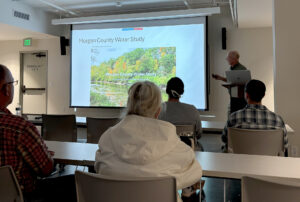
Last Wednesday, Diamond and Soil & Water director Lisa MacPhee held a public meeting at the Morgan County Public Library in Martinsville to present to the nearly-30 people in attendance about the future of Morgan County’s water needs, as well as concerns about the lack of state oversight over private companies like AES Indiana.
The meeting mostly consisted of Diamond’s presentation, but by the end, members of the public voiced numerous frustrations with local government officials and Google.
Many straws
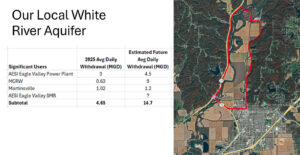
One of the most crucial questions explored in Diamond’s presentation was, “Is our source water (the White River) going to continue to be adequate to meet our water demands?”
The White River watershed extends from the Martinsville area, through Indianapolis, all the way to Muncie and beyond. The towns and cities along the White River watershed are experiencing significant economic growth — and nearly all need water.
Whether it’s big corporations like Google or Eli Lilly, local golf courses, or even school districts, there are a number of entities along the watershed that use a significant amount of water, and may even need more of it in the coming years.
Diamond said that 60 to 90 percent of the water distributed along the watershed ends up as wastewater, but importantly, some of the water does not return as wastewater and is lost. He identified a handful of ways the water could be lost, such as distribution system losses, outdoor water use, consumptive uses and industrial and commercial uses.
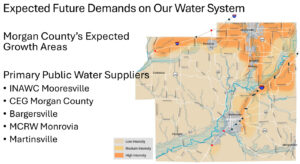
At the same time this is happening, Morgan County and others along the watershed — Fishers, Carmel, Plainfield, Greenwood and more — are expected to grow.
Eli Lilly’s LEAP project will use 25 million gallons of water per day from the Indianapolis water system. And Monrovia’s data center project will likely need 8 million gallons of water per day, Diamond said, and could be even higher according to testimony from a Google engineer back in 2025.
Much of these projections are based on known plans, but some are still unknown.
Top of the list for Diamond is the possibility of a small modular reactor at the Eagle Valley power plant in Martinsville. AES Indiana has said it is exploring the possibility of building a nuclear power plant at Eagle Valley, but it has not confirmed if it actually plans to do so. How much water the plant will require if it is constructed is still an open question.
Ultimately, Diamond’s presentation culminated in a statement of concern regarding water quantity.
“With the anticipated growth and increased water use upstream in the White River watershed, if we do not work closely now and in the coming years with all upstream stakeholders, the flows in the White River may at some point not be adequate during extended dry periods to recharge our local aquifer fast enough to produce all the water needed to supply Morgan County Rural Water’s customers, the Google data center and the Eagle Valley power plant,” Diamond said.
“During extended low flow periods,” Diamond added, “when the concentrations of potentially harmful chemicals coming from upstream municipal and industrial discharges are higher, compliance with and enforcement of environmental rules and regulations are more important than ever for the protection of the river ecology and our drinking water systems.”
Diamond concluded his presentation with a discussion of state legislation in recent years that has weakened both wetland protections as well as the Indiana Department of Environmental Management’s (IDEM)ability to regulate.
He spoke about the 2021 law that removed protections for all Class 1 wetlands and most Class 2 wetlands. In 2024, wetland protections were further weakened when legislation reclassified many Class 3 wetlands as Class 2 wetlands, which do not receive much oversight.
In 2023, IDEM was prohibited from regulating coal combustion residuals to a greater degree than federal regulations, and as of this year, IDEM has no ability to oversee nuclear power generating facilities.
This year’s Senate Bill 277 included more than 40 administrative changes that reduce IDEM’s regulatory functions.
Public anger
Following Diamond’s presentation, members of the audience were invited to ask questions, which often quickly became heated discussions. The first to ask a question wanted Diamond to speak more about IDEM’s inability to oversee nuclear reactors, which paves the way for private companies to only receive oversight from federal regulators.
“Even if (federal regulators) did a great job, they’re not here locally,” Diamond said. “I’m not comfortable in saying that we can only rely on the federal government to watch out for us here in Indiana.”
Another member of the public responded to Diamond’s remarks by casting ire on Morgan County officials.
“I hear what you’re saying about the federal government,” the man began, “But we started with the local government. We opened ourselves up for this by letting it come in, first. So, now we’re saying we’re gonna blame the federal government for not controlling this, but didn’t we start with the local government allowing the data center and all the other (companies) taking away from our system?
“I mean, we still don’t know answers about Google,” the man continued. “Where’s the water? Where is it going? What are we going to power it up with? Right? I think we’re on the same page, but we got so many questions tonight, and we don’t even know the right question to ask.”
Other members of the audience expressed disappointment that some local officials who supported the data center have been reelected.
The meeting ultimately ended with Diamond expressing his hope that more coordination would take place between counties along the watershed, and saying that he would continue to try and inform decision-makers and the public about the pressing issue of water in the future.