


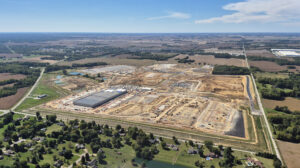
MORGAN COUNTY — The Morgan County Commissioners are seeking a summary judgement of their own to end a lawsuit filed in March 2025 concerning Google’s data center campus in Monroe Township.
Teresa L. Moore and Susan Boulianne Kessler are the plaintiffs in a lawsuit against the commissioners. They allege the commissioners were wrong to rezone agricultural property for planned unit development (PUD) and that by doing so the commissioners disregarded Morgan County’s Comprehensive Plan.
Additionally, the plaintiffs allege that Google’s data center would “significantly reduce” the value of properties located near the site.
The plaintiffs’ lawsuit was filed in March 2025, but progress seemed to stall around January 2026. In the meantime, construction on the data center campus has been in full swing, with roof work on the first building completed late last month.
There was no public activity in the case between January and Sept. 15, when attorneys on behalf of the plaintiffs filed a motion for summary judgment in Morgan County Superior Court 1, seeking to halt construction at the data center site east of Monrovia.
A motion for summary judgement is a request for a judge — in this case, Judge Dakota VanLeeuwen — to decide all or part of a lawsuit without holding a full trial.
“Uncontested facts show that in several respects, the (commissioners’) actions were arbitrary, capricious, an abuse of discretion, unsupported by substantial evidence, or not in accordance with law,” reads the plaintiffs’ Sept. 15 memorandum. “Plaintiffs seek a declaratory judgement to that effect and an order setting aside both rezonings.”
A month later, the county commissioners followed suit, filing a cross-motion for summary judgment on Oct. 15.
The county’s motion argues that the commissioners had a “rational basis” for granting Google the rezones it requested, and that the enactment of those rezones was “procedurally sound.”
“The court should grant summary judgement in favor of Morgan County and against the plaintiffs on all claims,” the cross-motion reads.

Counterarguments
In the cross-motion filed earlier this month, the county refutes arguments made by the plaintiffs. The county begins its argument by attempting to counter the “statement of material facts” offered by the plaintiffs in their request for summary judgment filed in September.
In their Sept. 15 filing, the plaintiffs frequently criticize the county for concealing Google’s identity for months, as much of 2025 passed before local residents definitively knew who would operate the data center.
The county argues that Google’s identity is not legally relevant.
“Plaintiffs’ statement of facts complains throughout that the identity of the developer and end user was concealed from them during Morgan County’s consideration of the PUD Ordinance I and the PUD Ordinance II,” the cross-motion reads, referring to the zoning ordinances.
“Plaintiffs refer to the identity of the developer and end user as ‘crucial information,’ but nowhere in (their) brief do plaintiffs explain why this information was crucial or legally required — because it was not,” the cross-motion continues. “Morgan County does not dispute these facts, but disputes the legal relevance of those facts to the issues before this court.”
The county’s cross-motion also rebukes the plaintiffs for highlighting residents critical of the data center but neglecting to mention residents who spoke in support of the data center development during the Feb. 2025 meeting of the Morgan County Plan Commission.
“Hiram Trisler stated ‘he is in favor of the data center because he worked in this field for over 40 years and has seen the benefits it can bring to a community,’” the cross-motion reads. “Justin Clements said he ‘is excited about the jobs this will bring to the county. He created a tech business and would have loved to (have) kept it in Morgan County, but at the time the area did not have the things he needed so he had to move it outside the county.’”
Commissioner Bryan Collier, in a declaratory statement filed along with the county’s cross-motion, gave his opinion about the public’s comments at the Feb. 2025 plan commission meeting.
“After listening to the entirety of (Google’s) proposal, I observed the public commentary,” Collier said. “Four individuals spoke in favor of the petition. Thereafter, about 30 people spoke in opposition. Morgan County has a population of nearly 75,000 residents. The opposition was a vocal minority that represents less than one-half of a percent of the Morgan County residents I represent.
“I heard and considered the concerns voiced at the meeting,” Collier continued. “One of my concerns was that the minority represented is against economic growth of any kind, including the growth we have experienced in neighboring Hendricks County — for which Morgan County receives no significant or measurable economic benefit.”
Collier went on to say that various complaints about the data center plans — including concerns about noise, economic growth, environmental issues, adverse health effects, effects on wildlife, property values and more — were either addressed at the meeting or were raised by people who lived outside of the county.

The county’s position
In the plaintiffs’ memorandum requesting summary judgment, they accuse the commissioners of failing to give reasonable regard to Morgan County’s comprehensive plan.
“The comprehensive plan calls for commercial, mixed use, or residential development of the parcels proposed for Data Center I, not industrial development,” reads the memorandum. “For the parcels proposed for Data Center II, the comprehensive plan calls for mixed use and agricultural development, not industrial development. A data center, like a factory, uses mechanical equipment (computers) to manufacture a product (information) and therefore should be considered an industrial activity.”
The county sees the situation differently, arguing that the court has only to determine whether the commissioners had any “rational basis” for approving the zoning ordinances in dispute.
“The objective, undisputed facts show that the (commissioners) paid reasonable regard to Morgan County’s comprehensive plan, to the current conditions and character of current structures and uses in the relevant district, to the most desirable use for which the land in the district is adapted, to the conservation of property values throughout the county, and to reasonable development and growth,” the cross-motion reads.
Commissioner declarations
Collier and Commissioner Don Adams defended themselves in their declarations released alongside the cross-motion.
Collier said that he learned in fall 2024 that Woodland Caribou LLC — one of Google’s shell names — was looking to build a data center outside Monrovia. To learn more about their plans, he signed a non-disclosure agreement.
Both Collier and Adams said they attended “several informal meetings” with Google to learn more and to ask questions. Additionally, Collier “attended or viewed online” informational hearings and town halls about data centers.
“The feedback I received from constituents and friends about the proposed data center generally was more positive and neutral than negative,” Collier said.
Collier added that throughout the early stages of data center talks, he was “mindful” of Hendricks County allowing Google to operate there should plans in Morgan County fall through.
Eventually, Collier discussed the Feb. 2025 meeting of the commissioners, following the meeting of the plan commission where the latter body recommended rezoning land for data center use. He says that the county’s attorney, Anne Cowgur, “reminded” the commissioners of the factors to consider when making their decision, including the county’s comprehensive plan.

“Our Morgan County comprehensive plan calls upon us to welcome growth and, in particular, to ‘welcome industry in the northwest portion of the county, which takes advantage of the proximity to Interstate 70,’” Collier said. “The proposed rezoning fit with this goal, and that was a major consideration for me in approving the PUD I ordinance.”
Collier said a data center campus would be preferable to a “200- or 300-home housing development” that would strain Monrovia’s resources. He added that he believed Google would pay for infrastructure upgrades in and near the town.
County officials have long argued that bringing Google’s data center to Monroe Township was necessary due to the loss of property tax revenue resulting from 2025’s Senate Enrolled Act 1, an argument Collier repeats in his declaration.
Collier then addressed the plaintiffs’ concerns that properties near the data center would see depreciating values.
“I realize that some people suggest, without proof, that the data center will reduce property values for those in the immediate vicinity of the data center,” Collier said. “At least one comment by a local resident indicated more jealousy and frustration that the resident’s neighbors had received above market value for their properties and that resident had not been offered a buyout. The actual effect on neighboring property owners remains to be seen, as they, too, may be offered above market prices based on other business opportunities surrounding the data center.”
Collier’s declaration also addressed the issue of how many jobs the campus would create. He says that he’s heard complaints that “only 50” jobs would be created, and argued that 50 jobs would be good for a small community like Monrovia.
However, he adds that, at one time, he understood that there would be 125 jobs at the campus, and now he’s heard that there may be 450 jobs at the data center.
Adams said he visited a data center in New Albany, Ohio, which “employed 75 full-time employees in just security personnel,” and he was optimistic it would create “good-paying jobs in the Monrovia area to attract and keep more of our youth.”
Collier points to the county’s financial benefit as justification for approving the zoning ordinances, saying that Google has agreed to pay a minimum of $1 million in property taxes, or $300,000 per data center building, whichever one is greater.
Collier closed his declaration by confronting his critics.

“It is frustrating to me that certain people believe that we, as commissioners, were doing something ‘to Monrovia’ when we are trying to do something ‘for Monrovia’ and the county at large,” Collier said.
“In my nearly three decades of public service, this entire experience has been personally and professionally agonizing,” Collier continued. “I have followed the law and my heart. I continue to believe that the vast majority of the constituents I serve are either supportive of the data center project or neutral.
“However, the vocal minority has taken a significant toll on me. I have been threatened with physical harm in person and on social media. I have been recklessly accused of being bribed or personally taking kickbacks with no evidence, investigation or reasonable inquiry into the truth of these allegations, which are absolutely untrue. I have lost business in my career.
“It has taken a toll on my mental health, my marriage and my kids. Through it all, my only solace is that I continue to believe that I did what is right and best for a county that has been my lifelong home,” Collier concluded.
Much of commissioner Adams’ declaration repeated verbatim many of the same things in Collier’s declaration, though Adams defended his actions based on his experience as a retired teacher, arguing that the data center would serve as a “catalyst for learning and training and an opportunity to provide jobs to keep local graduates in the county.”
“I understand that some people, not a majority, but some, in my district disagree with my vote in favor of the rezoning decisions and my approval of PUD I and PUD II,” Adams concluded. “However, I continue to believe that this decision is in the best interest of my kids and grandkids, the students I taught in school, their kids and grandkids and the greater good of Morgan County.”
Hearing scheduled
The dispute between the plaintiffs and the commissioners will come to a head next week. A hearing on the motions for summary judgment will take place on Wednesday, Nov. 4 at 3 p.m. at the Morgan County Judicial Center. Judge VanLeeuwen will preside.