
MARTINSVILLE — The Metropolitan School District of Martinsville (MSD) School Board held the first of two public hearings last Thursday evening on a resolution that would authorize the school district to issue up to $60 million in bonds to pay for capital projects.
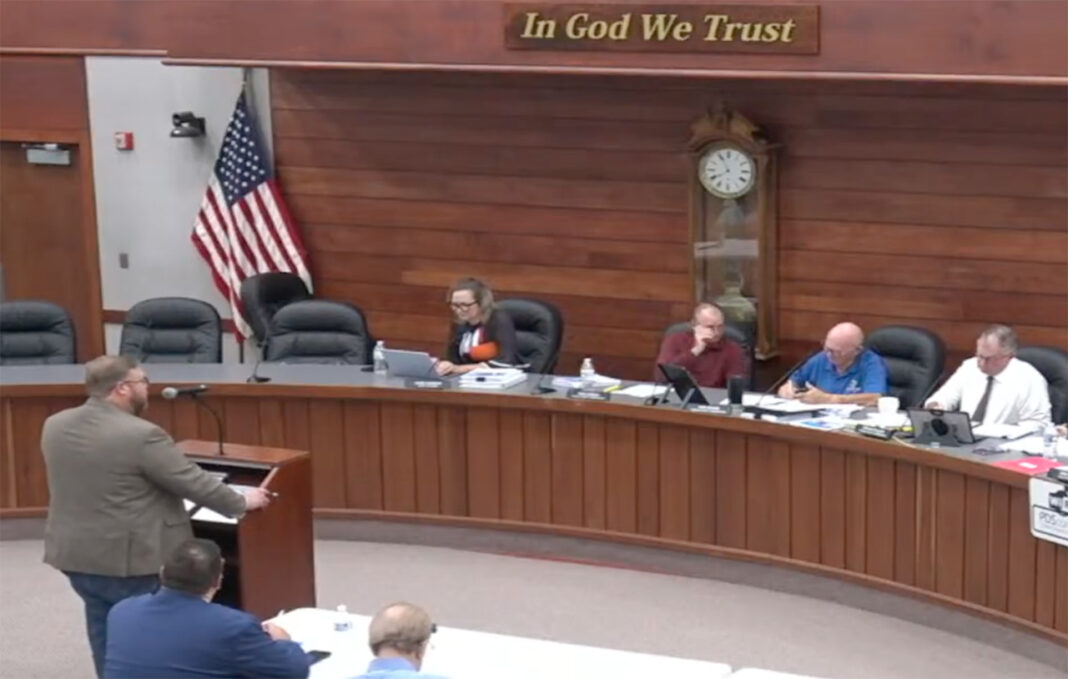
Representatives from law firm Bose McKinney and accounting firm Baker Tilly both delivered presentations to the board on the resolution.
Jacob McClellan of Bose McKinney explained that the resolution was up for consideration due to financial uncertainty in the wake of 2025’s Senate Enrolled Act 1 (SEA 1), which cut property taxes and has affected school districts across the state.
The proposed general obligations bonds have a maximum borrowing amount of $60 million and an assumed repayment term of 20 years.
The estimated interest cost is just over $35 million, which is based upon assumed interest rates of 5 percent. The maximum interest rate is set at 7 percent, meaning the maximum interest cost would rise to just over $51 million, according to the presentation.
If the district were to pay the maximum principal and interest, the MSD of Martinsville would be on the hook for more than $111 million over the next 20 years.
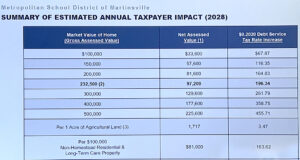
As for the effect on taxpayers, the estimated increase above the estimated 2027 debt service tax levy is $5,017,386. The estimated tax increase is $0.2020.
According to Baker Tilly projections, the average market value home in the area ($235,000) would see a $196 increase on its annual tax bill as a result of the proposed bond.
The district has a laundry list of more than two dozen capital projects it would complete with the money, including roofing upgrades at John R. Wooden Middle School, Poston Road Elementary and Martinsville High School; pool and weight room renovations at the high school; soccer facility renovations at the high school; HVAC and chiller replacements at Central Education Center, Brooklyn STEM and South Elementary, among many others.
The district, however, was insistent that the resolution under consideration does not necessarily require the board to approve any bonds.
“Essentially, this project is being authorized to preserve your ability to issue bonds over the next five to 10 years,” McClellan said. “And even if we authorize this, it’s gonna be within your power to actually proceed with issuing bonds.”
Board member Heather Staggs made the board’s position crystal clear at the end of the public hearing.
“Just to be clear, we’re just asking for authorization,” Staggs said. “We are not issuing bonds.”
The board will hold a second public hearing on the resolution at its next meeting on Oct. 8. McClellan said there will be an additional public hearing that follows that, though he did not say when that would be.
Following the public hearings, there will be a 30-day remonstrance period when residents can petition to put this authorization resolution on the ballot as a referendum.
“Assuming that doesn’t happen, we’d be back in December,” McClellan said. “There will be another public hearing for the lease. The lease is the vehicle to get payment to the building corporation to issue bonds. The final authorization would be in January.”
At that point, if the board wanted to, it could begin issuing bonds after the January authorization. While $60 million is the maximum the district would be able to authorize, the board could vote to authorize bonds in any amount less than that, and the board would not necessarily have to issue any bonds at all.
The MSD of Martinsville has accumulated a high amount of debt in recent years in pursuit of various capital projects, notably the building of a new elementary school on Centennial Road and a brand new natatorium for the high school.
These projects, as well as other smaller projects, have seen the district’s debt climb higher than $160 million, including interest, just over the last three years. If the district were to issue the newest proposed bonds, the district’s debt would exceed a quarter of a billion dollars.

Attendance policy dispute
During the new business portion of Thursday’s meeting, board members Dan Conway and Matt Hankins argued about the district’s proposed attendance policy, which was ultimately passed 3-1, with Conway voting against the policy and board member Jacque Deckard absent.
The policy allows up to five excused absences related to illness, though the district gives teachers some discretion over whether to excuse a student’s absence.
Conway said he did not want to “support a timeline” — a hard limit of the number of excused absences a student could have — because he said some students get sick a lot and should not be punished if they miss more than five days. Conway also said he believed the policy would be difficult for administrators to accurately enforce.
Conway argued that having only five excused absences would cause students to come to school sick when they should be at home resting.
“I want my kids in school as much as anybody else,” Conway said. “I want everybody’s kids in school — when they should be. I don’t want them there when they’re getting other kids sick.”
Assistant superintendent Suzie Lipps said state law requires districts to report students to truancy officers if they had 10 or more unexcused absences. If students have 18 or more unexcused absences, school districts get punished financially per federal law.
Hankins forcefully defended the district’s proposed policy, arguing that if the district did not set parameters for excused absences, students would abuse the system and miss many more days of school than if there were no limits.
“I disagree with what Dan’s saying,” Hankins said. “I was a teacher for many, many years. You gotta have kids there.
“You have to have accountability,” Hankins continued. “We only are required by state law to go 180 days. And believe me, when you’re a teacher, that kid is not there for instructional time, they lose (learning). I don’t care what (reason) it’s for. I don’t care who the kid is, you lose instructional time.”
2027 budget
In addition to the public hearing on the proposed bond resolution, the board also held a public hearing on the proposed 2027 budget, capital projects and bus replacement plan.
MSD’s total budget for 2027 will be $61,333,825, almost $2 million less than last year’s budget.
The budget is the sum of three funding sources: Education ($33,600,000), Operations ($15,500,000) and Debt Service ($12,233,825).
The Education fund comes from the state, and is based on student enrollment. It largely funds teacher salaries and benefits.
The Operations fund comes from local property taxes, and is used to pay administrator salaries, buses, utilities and more.
Debt Service also comes from local property taxes, and is used to pay off debt associated with a school’s district’s capital projects.
Martinsville is pursuing a number of capital projects in 2027. These include building and grounds improvements ($200,000), flooring improvements ($100,000), lighting improvements ($75,000), signage ($25,000), education equipment ($200,000), security improvements ($100,000) and electrical and plumbing infrastructure ($200,000).
The district plans to replace two buses every year from 2027 until 2031. The district estimates the cost of replacing two buses in 2027 will be $343,166, or $171,583 each.
The estimated cost of replacing two buses a year for the remaining four years is $1,632,468.
The next meeting of the MSD of Martinsville school board will take place on Thursday, Oct. 8 at 7 p.m. at the Central Education Center, 389 E. Jackson St.