
MONROVIA — The town of Monrovia may soon become considerably larger — and town officials may be on their way to collecting significantly more property tax revenue.
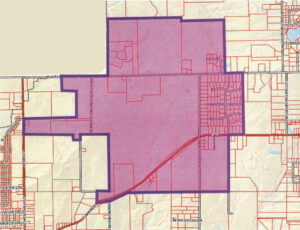
The Monrovia Town Council discussed a number of important issues at its monthly meeting last week, but perhaps none more consequential than a resolution initiating proceedings for an “eastside annexation” that would expand the town’s limits all the way out to Keller Hill Heights, and would encompass the entirety of the land containing Google’s planned data center campus.
For more than a year, Monrovia residents have been grappling with how to react to Google’s planned data center, with many locals complaining that most of the decisions surrounding the project have been made by the county without the town’s knowledge or input. If Monrovia is able to annex the land the data center sits on, town officials will gain a lot more bargaining power, and the town’s tax base will grow tremendously.
During March 24 town council meeting, discussion of the annexation among the council was largely muted. Council president Tammy Everett said the resolution was just the start of a long process. Councilman Philip Fowler urged caution.
“I don’t know about this,” Fowler said. “Are we gonna get pushback from the data center people?”
“I’m not the data center people, so I don’t know,” Everett said.
“I think we might want to wait a little bit on this, just to see what kind of a response we get,” Fowler said. “I mean, if they want to throw money into stopping this kind of thing, then we’re spinning our wheels.”
“I’ll make a motion to accept the resolution,” council vice president Carol Youngblood said immediately after.
The motion was seconded by councilman Loren Moore, and the council approved initiating the annexation process by a 3-2 vote, with Fowler and councilman Ryan Marsh voting against the resolution.
Youngblood and Everett spoke with The Correspondent after the meeting about some of the implications for the resolution. Youngblood said the annexation would bring the town a lot of additional revenue, not just from the data center but from the properties at the Keller Hill Heights neighborhood.
Everett added that Google will likely need to use the town’s sewer system for the data center, perhaps giving the company an incentive to be annexed.
“We have a huge responsibility to our taxpayers to expand as necessary,” Everett said.
“Our citizens are the ones putting up with the data center,” Youngblood added. “If they have to live next to it, they should be able to reap some benefits.”
The approved resolution outlines some of the next steps the town will have to take to annex the land.
Monrovia will have to “develop proposed plans for the extension of capital and noncapital services” in the area, as well as determine an estimated fiscal impact.
Then a public hearing must be conducted, and the town “desires to conduct outreach meetings to inform citizens regarding the proposed annexation.” Prior to said outreach meetings, the town anticipates “providing notice to landowners of the dates, times and locations of public information meetings to provide citizens with information regarding the proposed annexation.”
It’s unclear how the county will respond to Monrovia’s resolution. When the town previously appealed to the Indiana Utility Regulatory Commission (IURC) to allow Monrovia to declare an exclusive wastewater service territory on land that included the data center, the county testified in opposition to the move, and the IURC sided with the county.
Eagle Pointe rezone
As expected, the council voted to heed the plan commission’s recommendation to rezone the Eagle Pointe property across the street from residential to agriculture (AG).
The zoning status was previously planned unit development (PUD), and Indianapolis-based home builder Gradison had intended to build a subdivision on the property. Gradison repeatedly struggled to get council approval for its neighborhood plans, as council members objected to the close proximity of each home, which they feared would be a fire hazard.
Rezones are typically initiated by the property owners themselves, but Gradison did not want Eagle Pointe rezoned to AG. Gradison representatives repeatedly pleaded for the plan commission to reconsider, arguing that an AG designation would significantly devalue the property.
Everett led the charge to rezone the property. She said that while she hoped the land would someday be developed for commercial use, she believed Gradison had waited too long to develop anything.
She also has argued that the town’s Unified Development Ordinance requires an application for site plan approval to be filed within 18 months of PUD ordinance approval. Because Gradison never received site plan approval, the town had the right to rezone the property to its original designation.
The council voted 3-2 to rezone the property, with Fowler and Marsh voting against the recommendation.
The next meeting of the Monrovia Town Council will take place on Tuesday, April 28 at 6:30 p.m. at the Government Center, 60 South Marley Way.